
FemiPro Ingredients: Label Analysis, Evidence & Limitations
What's actually printed on the FemiPro label, what independent research says about each ingredient, and what remains unclear.
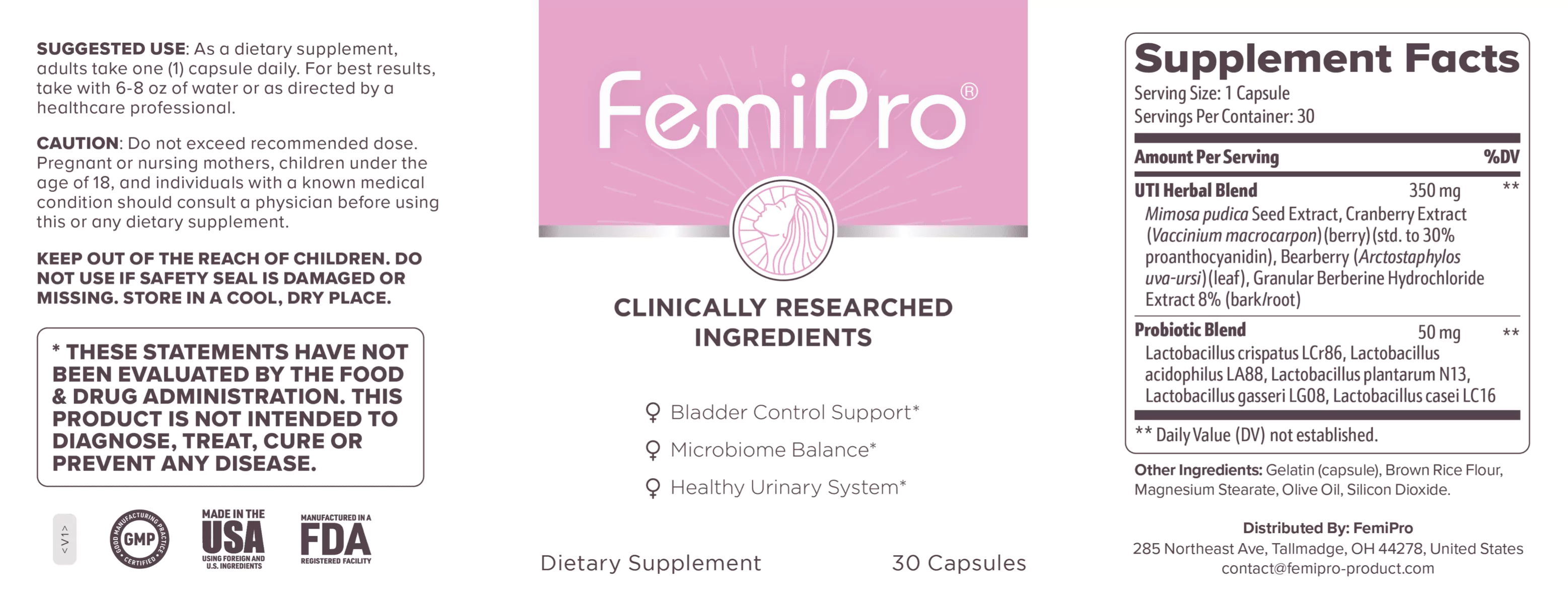
FemiPro's label lists five named ingredients. Below is an evidence-based breakdown of each, using the product label as the primary source. Where the label does not disclose an amount, strain, or count, we say so directly rather than estimate.
| Ingredient | Label Amount | Proposed Role | Evidence Level | Safety Notes |
|---|---|---|---|---|
| Mimosa Pudica | Not disclosed | Traditionally used for digestive and urinary "cleansing" support | Limited human clinical evidence for urinary support specifically | Generally used in traditional herbal contexts; talk to a doctor if pregnant or on medication |
| Bearberry (Uva Ursi) | Not disclosed | Traditional herbal support for the urinary tract | Long traditional use; Health Canada publishes a monograph with use conditions | Not recommended for extended continuous use or during pregnancy without medical advice; see the Health Canada bearberry monograph |
| Cranberry Extract | Not disclosed | Studied for reducing bacterial adhesion in the urinary tract | Most-studied ingredient in the formula; clinical evidence on UTI prevention is mixed | Generally well tolerated; may interact with blood-thinning medication in concentrated forms |
| Probiotic Blend | Strain(s) and CFU count not disclosed | Intended to support a balanced urinary/gut microbiome | Probiotics broadly studied, but effects are strain-specific; undisclosed strains cannot be evidence-matched | Mild digestive adjustment is possible when starting; caution for immunocompromised individuals |
| Granular Berberine | Not disclosed | Studied for antimicrobial and metabolic (glucose-related) properties | Reasonably well studied as a compound; not specific to FemiPro's formula or dose | Can interact with diabetes medication and other drugs; the NCCIH publishes berberine safety notes |
What the Label Discloses vs. What It Doesn't
Disclosed
- The five named active ingredients
- General "natural ingredients" and Non-GMO claims
- GMP-certified, FDA-registered-facility manufacturing claims
Not Disclosed
- Milligram amounts per capsule for any ingredient
- Probiotic strain identity and CFU count
- Extraction standardization (e.g., cranberry PAC content)
- Full inactive-ingredient/excipient list
Ingredient Research vs. Finished-Product Evidence
It's important to separate two different things: research on an isolated ingredient (like cranberry extract in a specific clinical dose) and evidence for a finished multi-ingredient product like FemiPro. A positive study on cranberry extract at, say, 500 mg standardized to a specific PAC content does not tell us anything about FemiPro's undisclosed cranberry amount. Ingredient research can inform expectations, but it is not proof that FemiPro itself produces the same effect.
Why Dosage Transparency Matters
Two supplements can list an identical ingredient panel while one uses a clinically relevant dose and the other uses a token "fairy dust" amount. Without published mg or CFU figures, Canadian buyers cannot verify which category FemiPro falls into. If dosing transparency is important to you, our alternatives page outlines how to evaluate more transparently labelled products.
Check FemiPro's Current Label & Pricing